
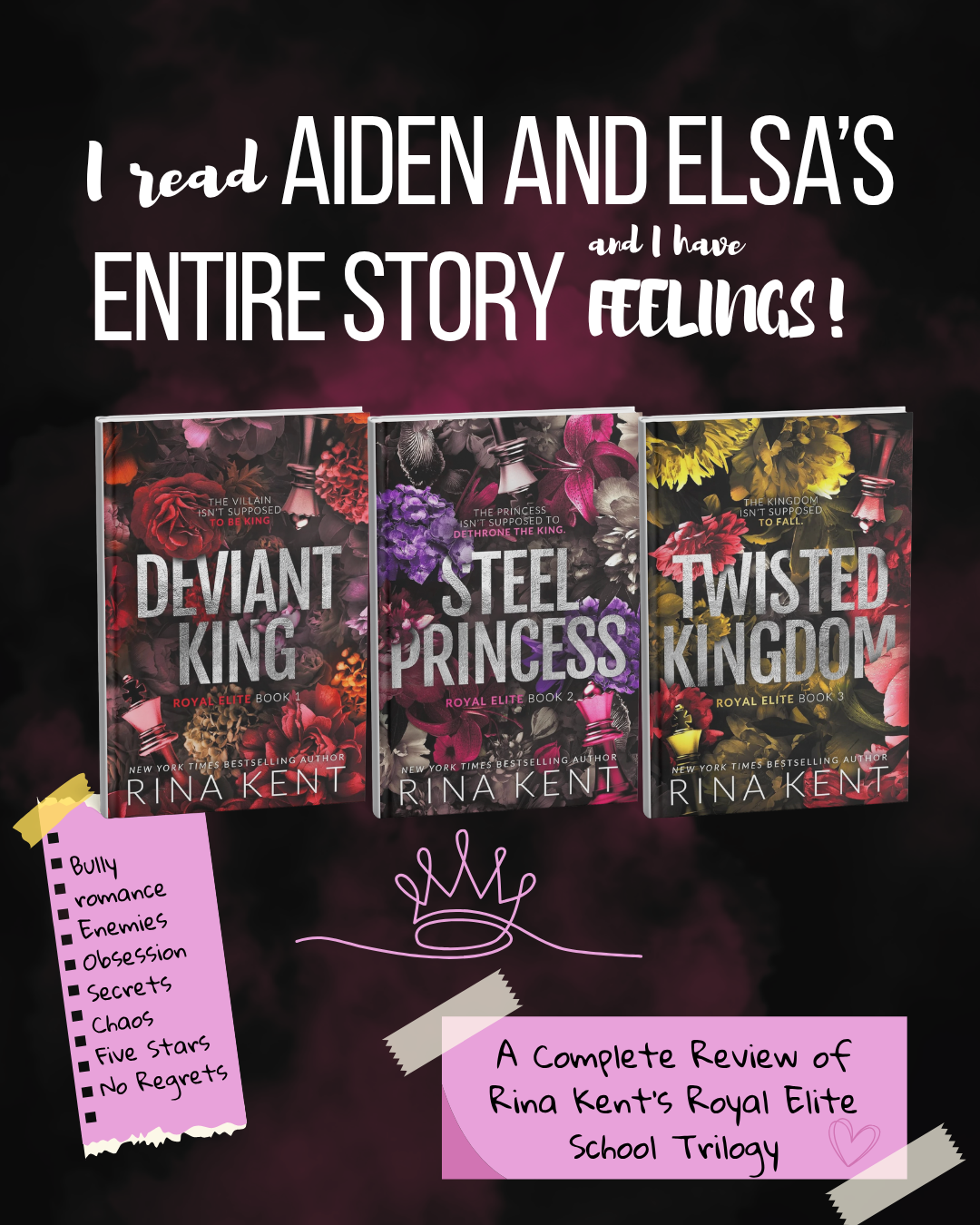

Before Deviant King, I was pretty sure bully romance wasn’t for me. The whole concept sounded like something that would piss me off more than entertain me. I pictured myself spending four hundred pages yelling at the heroine to develop some self-respect while wondering why anybody found the man tormenting her attractive.
Then I met Aiden King.
Apparently, my principles are negotiable under the right fictional circumstances.
Aiden and Elsa’s story makes up the central trilogy of Rina Kent’s Royal Elite series: Deviant King, Steel Princess, and Twisted Kingdom. It’s one continuous relationship spread across three books, so I don’t really think reviewing them individually makes much sense. You can certainly have a favorite installment, but the emotional arc, the mystery surrounding Elsa’s past, and Aiden’s gradual unraveling all depend on what happens across the trilogy.
I gave all three books five stars. I also finished them with the slightly concerning realization that I had gone from “I don’t think bully romance is for me” to actively searching Rina Kent’s backlist.
So let’s discuss how that happened.
Fair warning: there are spoilers for the entire trilogy below.
Deviant King: Or How I Got Into Bully Romance

My rating: 5 stars
My original Goodreads review for Deviant King begins with a very important question: Is Aiden a sociopath?
I remain comfortable asking it.
When Elsa arrives at Royal Elite School, Aiden immediately becomes a problem. He has money, status, intelligence, and enough social influence to make her life miserable without exerting much effort. He is controlling from the beginning, and once he decides Elsa has his attention, he seems to view her personal boundaries as mild suggestions he can evaluate at his convenience.
On paper, this should have enraged the absolute shit out of me.
What saved the book was Elsa.
A bully romance with a hero as overpowering as Aiden needs a heroine who can remain interesting while standing next to him, because his personality could easily swallow the entire story. Elsa pushes back. She gets angry. She keeps asking questions even when everybody around her seems determined to answer them with some variation of “you don’t need to know that yet,” which is one of the fastest ways to make me want information immediately.
She also doesn’t respond to Aiden’s intimidation by becoming meek. He absolutely gets under her skin, and there are moments when he manages to scare her, but she continues resisting him even when resistance makes her life more complicated. That mattered to me because I never wanted to spend three books watching Aiden simply overpower somebody who had no real agency of her own.
The other thing that kept me hooked was the mystery behind their relationship. Aiden knows things about Elsa that Elsa herself doesn’t know, and his reaction to her is far too intense to make sense based only on what she remembers. It becomes obvious fairly early that something happened before the beginning of the book, and Elsa’s missing memories make every interaction between them suspicious.
I am an extremely nosy reader. Once I know somebody is hiding something, I need to know what it is.
So while the sexual tension certainly helped, I was equally invested in figuring out why Aiden behaved as if Elsa had personally detonated a bomb inside his ass.
Why Aiden Works for Me as a Dark Romance Hero
Aiden is an asshole. I feel like we should establish that before we get into the analysis and accidentally make it sound as though I’m preparing his defense before the International Criminal Court.
He manipulates Elsa. He uses his social power against her. He tries to control what she knows, where she goes, and how much access other people have to her. If somebody behaved this way toward one of my friends in real life, the romantic outcome would involve blocked phone numbers and possibly a restraining order. If it was against me? You can bet your tushy I’d stab the motherfucker.
Fortunately, Aiden King is fictional.
That gives me considerably more flexibility.
With dark-romance heroes, I care much more about internal consistency than moral approval. If a character is going to behave terribly, I want to understand how his brain works. His actions need to make sense for the person the author has created, even when those actions are unreasonable, obsessive, or deeply fucked up.
Aiden makes sense to me.
Control is how he understands safety. His childhood taught him that adults could lie, families could fall apart, and terrible things could happen while the people who were supposed to protect him failed spectacularly. He learned to anticipate threats and keep himself several moves ahead of everyone around him. By the time we meet him, control has become so deeply ingrained that he barely seems capable of separating it from affection.
Then Elsa appears and refuses to behave predictably.
She challenges him. She keeps digging into things he would prefer to leave buried. She develops relationships with people he doesn’t necessarily want around her. Most inconveniently for Aiden, she becomes important enough that losing her is suddenly something he can’t treat like another problem to solve.
He handles this development with all the emotional maturity you would expect from Aiden King, which is to say almost none.
Steel Princess: When the Obsession Stops Looking Like a Game

My rating: 5 stars
Steel Princess is where I became much more interested in Aiden as a character.
The first book establishes that he is fixated on Elsa. The second book gives us a better look at what happens once that fixation starts interfering with how he usually operates.
Aiden is used to being the smartest person in the room. He plans ahead, reads people well, and generally assumes he can manipulate circumstances until they produce the outcome he wants. Elsa becomes the exception because his feelings for her are irrational enough to sabotage his usual methods.
He wants to protect her, but his idea of protection often involves controlling information. He wants her close, but he doesn’t necessarily know how to create closeness without possession. He wants her to trust him while simultaneously giving her several excellent reasons not to.
That contradiction is where the relationship became interesting for me.
Aiden wants Elsa to choose him, yet he is terrified of giving her enough freedom to make that choice without interference. The more emotionally invested he becomes, the worse his instinct for control gets. He can manage business, school politics, family secrets, and whatever other chess game happens to be running in his head. Feelings are apparently where the system crashes.
There is something extremely satisfying about watching a character who prides himself on being impossible to destabilize become completely destabilized by one woman.
I fully support this inconvenience for him.
Elsa Is Doing More Work in This Relationship Than She Gets Credit For
Aiden naturally dominates a lot of discussion around this trilogy because he is loud even when he isn’t speaking. His personality controls the room, and the entire premise of the series invites readers to analyze his behavior.
Elsa deserves at least as much attention.
She has to discover ginormous pieces of information about her own life while dealing with people who repeatedly decide that withholding the truth is somehow in her best interest. Her memories are unreliable, her family history is a mess, and Aiden has information he is reluctant to share. That could have turned her into a character who simply waits for everybody else to explain the plot to her.
Instead, Elsa keeps looking.
She wants answers badly enough to make people uncomfortable, which I appreciated immensely. She also keeps challenging Aiden’s assumption that loving her gives him permission to decide what she can handle.
That dynamic becomes especially important as the trilogy progresses because Elsa eventually understands exactly who Aiden is. She isn’t falling for a charming façade and discovering later that she misjudged him. She sees him for the manipulative bastard that he is. She experiences his cruelty firsthand. By the time she chooses him with full knowledge of what their relationship entails, that choice belongs to her.
That makes a HUUUGE difference to me in dark romance.
I don’t need the heroine to rehabilitate the hero until he qualifies for a healthy-relationship seminar. I do need her to have enough agency that I believe she understands the relationship she is entering.
Elsa does.
Twisted Kingdom: Somebody PLEASE, Tell Me What the Hell Is Going On!

My rating: 5 stars
By the time I reached Twisted Kingdom, I wanted answers almost as badly as Elsa did.
The trilogy spends the first two books dropping fragments of information about her childhood, Aiden’s family, their parents, the fire, her missing memories, and the web of relationships connecting all of them. Practically every adult seems to know at least one important fact they have inexplicably decided to keep secret.
This is how fictional parents create job security for therapists.
The final book has a lot of material to resolve, and this is where Aiden’s characterization landed best for me. Once more of his childhood comes into focus, his obsession with control becomes easier to understand. You can see the scared kid underneath the arrogance, even though the adult version of that fear has turned into seriously destructive behavior.
Understanding him and excusing him are two different things.
That distinction is part of why I enjoy dark romance. I can look at Aiden and think, “Oh, I completely understand how you became this person,” while simultaneously thinking, “Jesus Christ, man, stop, just… stop.”
The final book also gives Elsa a much firmer understanding of herself. She has spent so much of the trilogy trying to recover the truth that there is something satisfying about watching her finally make decisions with the full picture in front of her. Her relationship with Aiden changes because they are no longer operating around the same gaps in memory and information.
They still have problems. Obviously. But by the end, I believed they knew who they were choosing.
For this particular story, that was enough.
Rina Kent Understands Obsession
One of the biggest reasons this trilogy worked for me is that Aiden’s obsession actually feels obsessive.
Romance uses that word very casually sometimes. A hero remembers the heroine’s coffee order, thinks about her several times during the workday, and suddenly somebody is calling him obsessed.
That man is attentive. Calm down.
Aiden plans around Elsa. He tracks what affects her. He notices who is around her and reacts strongly when somebody threatens his place in her life. His decisions become increasingly shaped by what happens to her, and his need to keep her close repeatedly overrides the rational control he usually values.
That feels like obsession.
It also works particularly well in a dark-romance context because the intensity matches the genre. If I’m reading about a possessive hero, I want the possessiveness to affect the plot and the relationship. I want it embedded in his characterization instead of appearing only during sex scenes because the author remembered the trope list.
Aiden’s obsession creates problems. It makes him behave badly. It also exposes how vulnerable Elsa has made him, which is exactly why he fights the feeling so aggressively.
For a man who hates losing control, falling in love is basically an autoimmune disease he has no way to fight.
Would I Date Aiden King?
Absolutely fucking not. And as previously established, I’d stab him if he messed with any of my friends, because apparently I can match his freak but don’t want him as a romantic partner.
Also, he’s a teenager and I’m way older than him. But I digress.
I enjoy autonomy. I enjoy privacy. I have no desire to explain why my location services are disabled.
This is why I find conversations about whether dark-romance heroes would make good real-life partners slightly strange. That has never been the standard I use to judge them.
I read murder mysteries without evaluating whether the murderer seems suitable for brunch. I can enjoy horror without wanting a haunted Victorian child standing at the end of my hallway. Fiction has always allowed people to explore experiences they would reject immediately in real life.
Romance is no different.
The fantasy behind Aiden works because the intensity is enormous. There is something deeply compelling about the idea of a man who is almost impossible to distract becoming completely consumed by one woman. He notices everything about Elsa because she occupies that much space in his mind.
Would I want the actual surveillance and control that come with Aiden’s version of devotion?
Fuck, no.
But I enjoy reading about the intensity without having to live with the consequences, which is a pretty good arrangement.
Is Aiden and Elsa’s Story Actually Enemies to Lovers?
I would classify it primarily as a bully romance.
There is genuine antagonism between them, especially from Elsa’s perspective, so I understand why enemies-to-lovers gets attached to the trilogy. Aiden deliberately makes her life difficult, Elsa genuinely dislikes him for substantial portions of the first book, and their relationship has to move through that hostility before trust becomes possible.
Still, the emotional situation on Aiden’s side is much stranger than simple hatred.
Once the reader understands his history with Elsa and how long his fixation has existed, his behavior in Deviant King looks different. His cruelty is tangled up with obsession from the beginning, which considerably complicates the enemy label.
This is actually one of the reasons I liked the trilogy as much as I did. Their relationship changes meaning as you learn more about what happened before the story started. Scenes that look straightforward in the first book become more complicated when you know what Aiden remembers and what Elsa doesn’t.
That kind of recontextualization is catnip for me.
Why the Three-Book Structure Worked
I’m usually skeptical when a romance couple gets stretched across several books because there are only so many misunderstandings I can tolerate before I start wanting everybody to communicate like adults.
Aiden and Elsa actually needed the space.
Their relationship is tied too closely to the mystery surrounding their childhoods to resolve comfortably in one book. Elsa needs time to recover information about herself, and Aiden needs enough page space for the reader to understand how his fixation changes as more of the past comes to light.
The trilogy structure also gives their dynamic room to evolve. Deviant King establishes the hostility and mystery. Steel Princess pushes Aiden’s obsession into more emotionally vulnerable territory while Elsa becomes increasingly determined to uncover the truth. Twisted Kingdom finally resolves the history that has been shaping both of them.
Could some of it have been tighter? Sure.
Did I care while I binged all three?
Clearly not enough to deduct a star.
So, Did Rina Kent Convert Me to Bully Romance?
Apparently.
I finished all three books with five-star ratings and immediately wanted more Royal Elite.
That does not mean I suddenly love every bully romance. A hero being cruel to the heroine is not automatically interesting, and I still need enough characterization to understand what keeps the relationship compelling beyond the shock value.
Aiden worked because Rina Kent gave his behavior a psychological structure. I could follow the connection between his childhood, his need for control, and his increasingly irrational attachment to Elsa. Elsa worked because she continued developing outside his obsession and maintained enough agency for me to believe her eventual choice.
Most importantly, I had fun reading them.
I gasped at reveals. I got angry at characters. I stayed up far later than I should have because “one more chapter” remains one of the oldest lies readers tell themselves.
By the end of Twisted Kingdom, I was completely invested in these ridiculous rich people and their catastrophically complicated family histories.
And somehow, after three entire books of Aiden King behaving like Aiden King, he still isn’t my favorite Royal Elite man.
That honor belongs to Ronan Astor.
Don’t worry, we’ll get to him.
Leave a Reply